
Phone Poll: The Complete Guide to Telephone Polling in 2026
Phone polls have stood the test of time. While many predicted their demise with the internet’s arrival, the reality is they remain one of the most reliable methods for gauging public opinion, political sentiment, and consumer attitudes.
Despite all the digital technology available, phone polls offer something online forms simply can’t match: real conversations with real people. In 2026, the evolution of this methodology powered by AI has taken things to a completely new level.
What is a Phone Poll?
A phone poll is exactly what it sounds like: contacting people by telephone to gather their opinions on specific topics. It could be something as simple as a quick question about political preferences, or a more extensive questionnaire exploring attitudes toward products, service satisfaction, or complex social issues.
What makes phone polls special isn’t just the medium, but what they allow you to achieve. You can reach people who would never respond to an online survey, clarify confusing questions instantly, dig deeper when an answer deserves more exploration, and capture spontaneous reactions that reveal what people really think.
Why Phone Polls Still Matter in the Digital Age
Superior Sample Quality
Here’s the problem with online surveys: only people who see them and choose to participate respond. That’s self-selection bias at its worst. Phone polls, especially those using random digit dialing, give you a sample that actually reflects the population you’re trying to understand.
Completion rates speak for themselves. While email surveys crawl along with rates below 5%, well-designed phone polls achieve rates of 15-30%. Why? Because there’s something powerful about a real-time conversation that you can’t replicate with a static form.
Access to All Demographics
Let’s be honest: online surveys have a huge blind spot. Older adults, less tech-savvy people, communities with limited internet access—they’re all systematically excluded. Phone polls reach these essential groups.
And then there’s “satisficing,” that terrible habit of rushing through online surveys selecting random answers. When there’s an interviewer on the other end of the line, people tend to take more time and give more thoughtful responses.
Types of Phone Polls
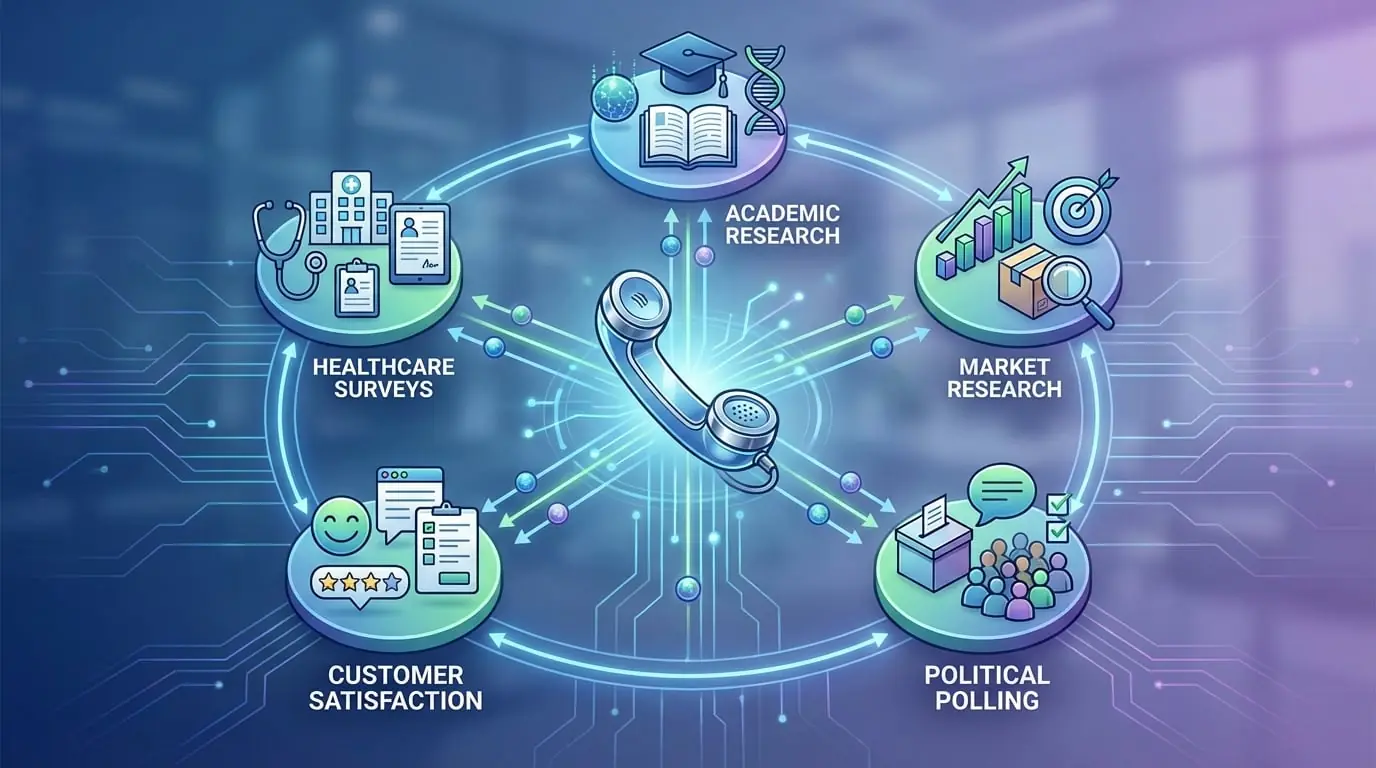
Political polls are the most visible, tracking candidate preferences, voting intention, and issue priorities. Businesses use them to test product concepts, assess brand perception, and measure customer satisfaction.
Academic institutions and government agencies leverage them to understand social attitudes, policy preferences, public health behaviors, and community needs. Organizations use them to measure employee engagement, conduct exit interviews, and assess organizational culture.
The AI Revolution in Phone Polling
Traditional polls had a problem: they required armies of human interviewers. The emergence of AI voice agents has changed the entire game.
Now you can conduct thousands of simultaneous interviews. What used to take weeks completes in hours, and the cost per interview doesn’t increase. Traditional costs included wages, training, supervision, and facilities. AI eliminates 60-80% of these expenses while improving data quality.
AI delivers every question identically, eliminating interviewer bias. It operates 24/7, reaching people at convenient times without paying premium rates. Real-time analytics identify trends continuously. And quality control is total: every conversation is recorded and transcribed.
Designing Effective Phone Polls
Duration and Focus
For general public, aim for 5-7 minutes maximum. With specialized audiences like customers or employees, you can extend to 10-15 minutes. But keep the topic clear and focused.
Start Strong
The first 15 seconds determine everything. Clearly identify who’s calling, explain the purpose concisely, estimate time accurately, assure confidentiality, and sound professional yet friendly.
Conversational Language
Speak like real people speak. Forget complex structures and academic jargon. Ask naturally: “How satisfied are you with your internet service—very satisfied, somewhat satisfied, somewhat dissatisfied, or very dissatisfied?”
Balance Question Types
Closed-ended questions are perfect for quantitative analysis. But strategic open-ended questions reveal unexpected insights. For scales, use 4-5 points maximum. Repeat options after the question and consider offering “don’t know” or “prefer not to answer.”
Test Before Launching
Never launch without a pilot. Test with a small sample first. Identify confusing questions, verify time estimates, assess flow, and test skip patterns.
Sampling Strategies
Random digit dialing (RDD) is the gold standard, generating numbers randomly to maximize representativeness. Sample lists with known demographics offer targeted sampling and higher contact rates, but quality varies.
Many modern polls combine landline and mobile sampling, RDD and list-based approaches. For national polls, 1,000 completed interviews typically provide ±3% margin of error. Regional polls may require 400-600 completes for ±5%.
Maximizing Response Rates
Timing matters. For general public, late afternoon and early evening work best. Mid-week outperforms Monday and Friday. It may take 6-8 attempts to reach some respondents.
Effective protocols vary times and days, leave voicemails, use text pre-notifications, and schedule callbacks. Incentives (charitable donations, prize drawings, exclusive results access) can help if calibrated well.
Analyzing Data
Raw data almost always requires statistical adjustment. Weighting and post-stratification match your sample to known benchmarks like census data. Professional software often includes these capabilities.
Tracking polls over time reveal directional movement in attitudes, seasonal patterns, the impact of specific events, and leading indicators of change. Open-ended responses require thematic coding, sentiment analysis, and AI-powered natural language processing.
Ethical Best Practices
Transparency is essential. Respondents should know who’s conducting the poll, who’s sponsoring it, how their information will be used, and their right to decline. Data protection requires secure storage, GDPR/CCPA/TCPA compliance, and genuine consent.
Maintain integrity using neutral wording, randomizing order when appropriate, and balancing response options. And never disguise sales or fundraising as research.
Challenges and Solutions
Response rates have declined across all modes. Solutions include shorter surveys, pre-notification, natural AI voice technology, and scheduled callbacks.
Mobile phones present different dynamics. Shorter interviews work better. Text-to-web options for complex questions and callback scheduling become crucial.
Caller ID skepticism is real. Register your caller ID with organization name, pre-notify identifying the number, and use local area codes when possible.
The Future
The future is likely AI-human hybrid models: AI handles straightforward interviews, complex cases escalate to humans. Polls will integrate with other modes: start by phone, complete by web, seamless switching based on preference.
AI will optimize in real-time with adaptive sampling, dynamic question ordering, and non-response prediction. Personalization will improve with matched voice characteristics, adapted pacing, and deep cultural customization.
Choosing a Solution
Evaluate methodology expertise in your domain, technology capabilities including AI voice quality, regulatory compliance, and capacity for your sample size. Solutions like Sonalyx combine AI voice technology with polling methodology expertise.
Getting Started
Define clear objectives: what decisions will the data inform? Determine sample requirements: who needs representation? Develop your questionnaire balancing comprehensiveness with brevity. Select methodology, choose technology, plan analysis, and establish realistic budget.
Conclusion
Phone polls remain essential for understanding public opinion, market dynamics, and organizational health. AI has addressed traditional limitations of cost, scalability, and speed while preserving core advantages.
The key is combining proven best practices with modern AI technology to achieve results that are faster, more affordable, and higher quality than ever. The future of opinion research is conversational, intelligent, and accessible.
Ready to conduct your next phone poll with cutting-edge AI voice technology? Discover how Sonalyx can deliver faster, more cost-effective results without compromising quality. Visit sonalyx.com to learn more.
Leer en español
Encuesta Telefónica: La Guía Completa de Sondeos por Teléfono en 2026