
CATI, CAWI and CAPI: A Practical Guide to Choosing the Right Methodology
If you’re new to market research or surveys, the acronyms CATI, CAWI and CAPI appear constantly without anyone stopping to explain them. If you’re experienced, you probably know them but may have found yourself in front of a client without a fully clear argument for choosing one over another.
This guide covers the fundamentals of all three approaches, their real practical differences, and the considerations that should guide the choice based on study type.
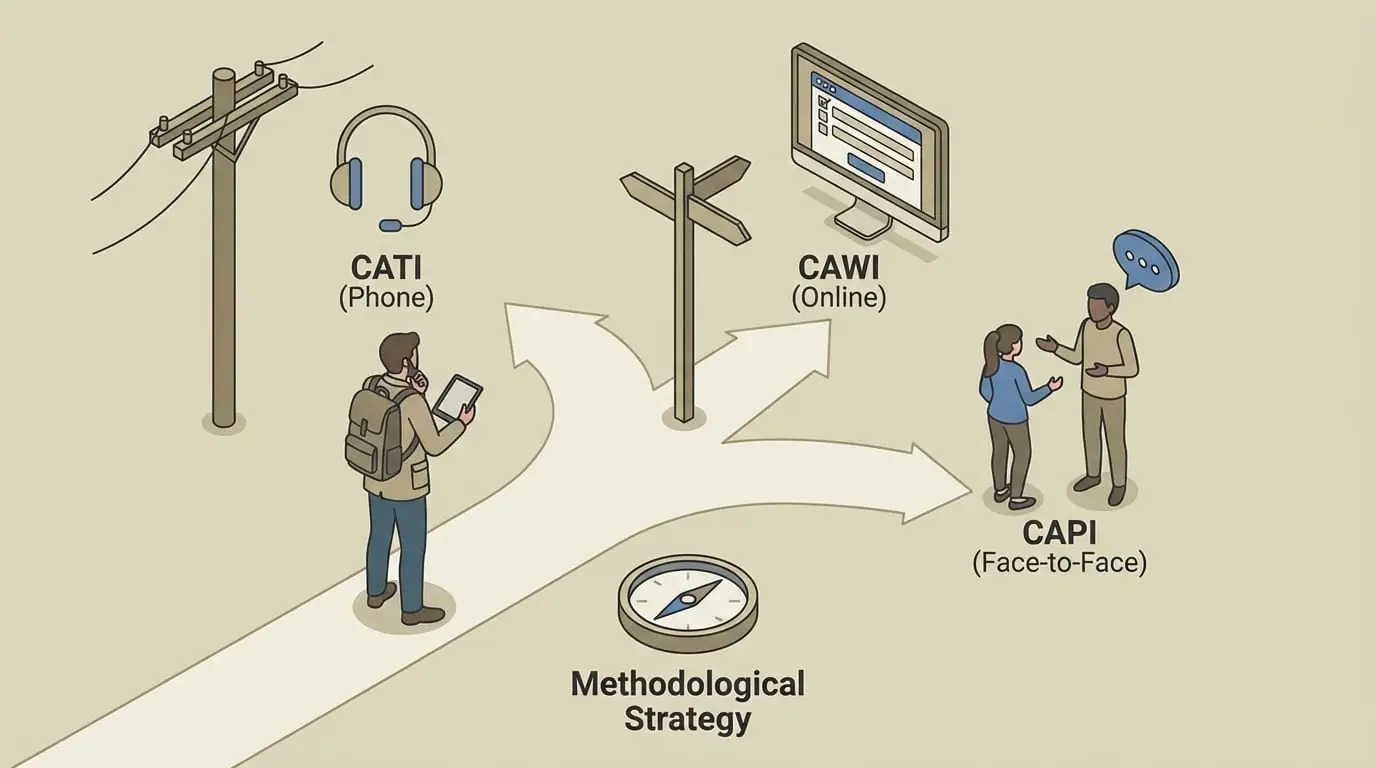
The Three Approaches and What They Share
All three methodologies have something in common: they use software to manage the questionnaire during the interview — the question flow, validations, and skip logic. What changes is the administration channel.
CATI (Computer-Assisted Telephone Interviewing) is telephone-based. An interviewer — human or, increasingly, an AI voice agent — calls the respondent and reads the questions while the software records the answers.
CAWI (Computer-Assisted Web Interviewing) is a self-completion online survey. The respondent accesses a web form and answers on their own, without any interviewer involvement.
CAPI (Computer-Assisted Personal Interviewing) is face-to-face. The interviewer meets physically with the respondent and uses a tablet or laptop to record responses.
What Distinguishes Each in Practice
Response rate is the first differentiating factor. CAPI achieves the highest rates (50-70%) because the interviewer is physically present and there’s an implicit social commitment. CATI typically achieves between 20% and 35%. CAWI is the lowest, between 5% and 15%, because it requires respondents to take the initiative to complete it.
Cost follows the reverse order. CAPI is most expensive because it involves travel, interviewer time, and logistical coordination. CATI with human operators has medium-high cost, though that’s changing with AI agents. CAWI is cheapest because there’s no human involvement.
The depth of information that can be obtained also varies. A 45-minute face-to-face interview can explore topics in far richer ways than a 10-minute web form. Telephone sits in the middle: it allows follow-up questions, but optimal duration rarely exceeds 15 minutes before respondents start dropping off.
The Bias of Each Methodology
Each methodology has its structural bias, and understanding it is essential for correctly interpreting the data.
CAWI over-represents populations with frequent digital access and technological competence. For studies where the target includes older adults or people with low digital skills, results can be heavily biased. Imagine an online shopping study addressed to the general public: if you launch via CAWI, you over-sample people who already shop online — because those are the ones seeing the invite in email or on web. Those who don’t shop online, or who shop rarely, are under-represented.
Traditional CATI has the social interaction bias problem: respondents tend to give more socially desirable answers when speaking with a person. This is particularly relevant in electoral studies or research on sensitive behaviors. When an interviewer asks “Did you use drugs in the last month?”, there’s implicit social pressure to answer “no” even if it’s untrue. With an online form, disinhibition is greater.
CAPI has the most pronounced interviewer effect of all, because the face-to-face relationship and time invested by the interviewer create very strong social expectation. But it also has the positive side that the interviewer can clarify doubts and capture non-verbal nuances that other methodologies lose.
Mode Effects and How to Manage Them
“Mode effect” is the phenomenon that the same question gets different answers depending on the channel. It’s not due to differences in respondents, but methodological differences. A respondent who gives NPS 7 when asked by phone might give NPS 5 when responding online, simply because speaking isn’t the same as writing, and there are differences in how anonymity is perceived.
For studies comparing channels, mode effect is critical to control:
CATI vs CAWI: Telephone tends to obtain higher satisfaction scores because of social desirability. People give more positive answers when speaking to someone than when answering anonymously. If you compare phone NPS vs online NPS, expect 1-2 points of difference due to mode effect.
CATI vs CAPI: Telephone tends to obtain less deep and less nuanced answers, because it’s harder to explore complex topics in a call than face-to-face. But CAPI can have a greater compliance bias because the respondent is more “captive”.
CAWI vs CAPI: CAPI gets richer and deeper answers, but CAWI gets more honest answers on sensitive topics because anonymity is greater. For a study on controversial behaviors, CAWI is better than CAPI despite lower response rate.
To manage mode effect in mixed studies:
- Document which questions were administered on each channel
- Do separate analysis by channel before combining
- Use statistical weighting techniques if combining samples from different channels
- Never assume a score on one channel means the same thing on another
When to Use Each
The choice should start with the study’s objective, the target profile, and the available budget.
CATI is the best option when you need genuine population representativeness, when the target includes people with low digital penetration, or when response rate is critical for study validity. It’s the default methodology for public opinion tracking and electoral studies, where historical comparability matters and you need to reach all population segments. With the cost reduction brought by AI agent solutions like Sonalyx, CATI is becoming viable again for projects where it was previously ruled out on budget grounds.
CAWI fits when the budget is limited, the target is young and digitally savvy, or when the questionnaire requires visual elements. For UX research, advertising testing with graphic materials, or product research where images need to be shown, CAWI is the only practical option. It’s also ideal when you need to complete very long questionnaires (30+ questions) where phone administration would have unacceptable drop-off rates.
CAPI is reserved for qualitative or semi-qualitative studies requiring depth, for very long questionnaires nobody would complete online on a voluntary basis, or for targets that can only be reached in specific physical contexts — shoppers at point of sale, event attendees, patients at a clinic.
Mixed Methodology Studies
The current trend in market research isn’t to choose one methodology but to combine them intelligently. A study can use CATI to reach segments with difficult digital access and CAWI for the rest, reducing costs without sacrificing representativeness. Or it can use CAWI for a main sample and CAPI for a depth sub-sample of qualitative interviews.
Example: a bank wants to measure customer satisfaction. It uses CAWI for customers under 45 (high digital access, 70% of sample), CATI for customers 45-65 (medium digital access, 25% of sample), and CAPI for those over 65 (low digital access, 5% of sample). With this strategy, it achieves representativeness without prohibitive costs.
Mixed design has its complexity: you need to manage mode effects (the same questions yield different results depending on the channel) and data can’t always be combined directly without statistical corrections. A satisfaction question might score 7.5 on CATI, 6.8 on CAWI, and 7.9 on CAPI. To combine into a single index, you need to apply correction factors.
Use Cases by Methodology
CATI ideal for:
- Regular public opinion tracking
- Electoral and political surveys
- B2B market research with executives as targets
- Post-service customer satisfaction
- Employee engagement
- Any study where reaching low-digitalization populations is critical
CAWI ideal for:
- Studies with young, digitally-savvy targets
- Creative testing or visual material tests
- Long studies (30+ questions)
- Very tight budgets
- UX research and product feedback
CAPI ideal for:
- Qualitative or ethnographic research
- Observational behavioral studies
- Specific contexts where presence is necessary
- Response depth requiring 45+ minutes of interaction
A Note on CATI with AI
CATI is undergoing a significant change with the emergence of AI voice agents. Historically, the cost of CATI with human operators was its main limitation, making CAWI more budget-competitive. AI agents maintain the methodological advantages of telephone — high response rates, capacity for complex questions, reach to non-digitalized populations — at a cost much closer to CAWI.
That’s fundamentally changing which projects are viable with telephone methodology. Studies that five years ago were done via CAWI for budget reasons can now be done via CATI with AI agents, obtaining response rates 3-5 times higher and better population representativeness, at the same cost or even less.
Leer en español
CATI, CAWI y CAPI: guía práctica para elegir la metodología correcta