
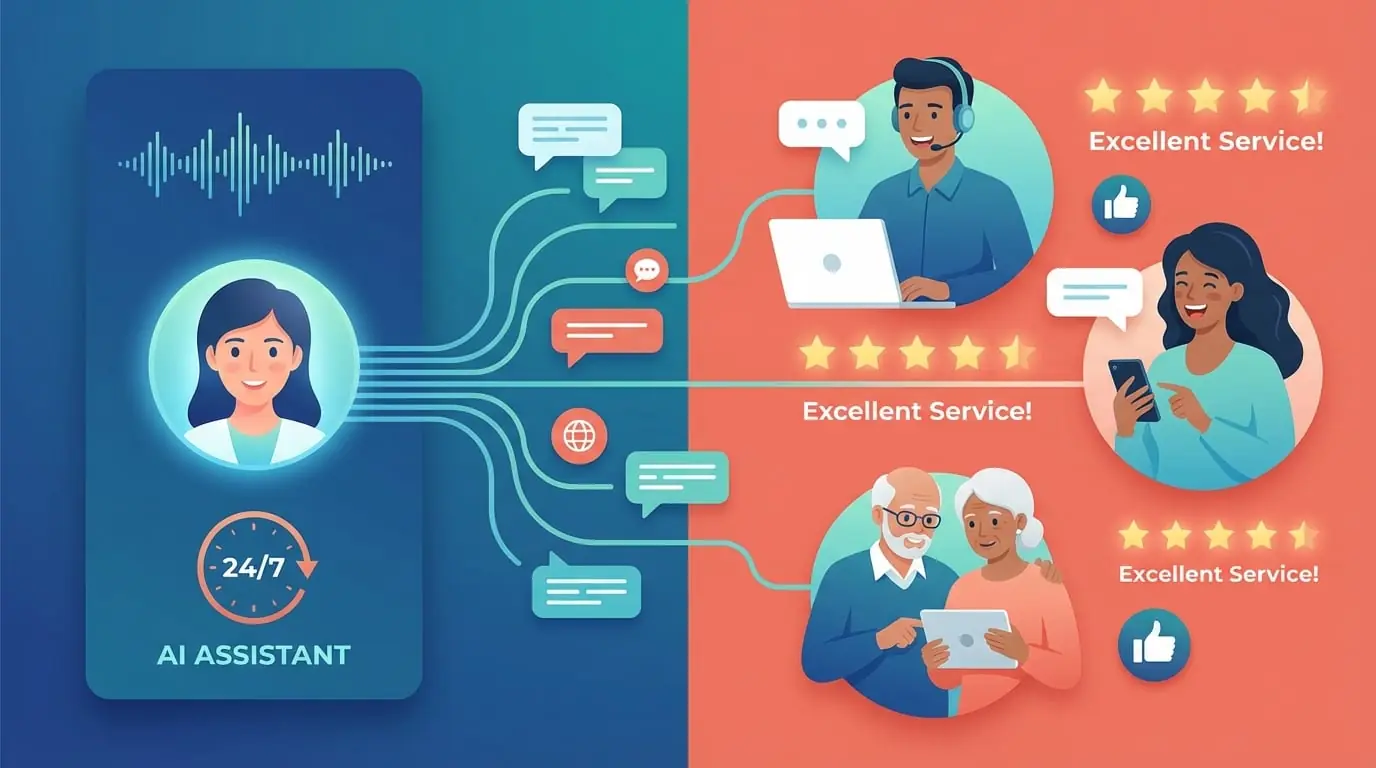
AI Voice Agent: Revolutionizing Business Communication and Customer Engagement
The rise of AI voice agents marks a transformative moment in how businesses interact with customers, conduct research, and automate communication workflows. These sophisticated systems go far beyond simple chatbots or interactive voice response (IVR) systems—they represent a quantum leap in conversational AI that can understand context, express empathy, and handle complex interactions that previously required human intervention.
What is an AI Voice Agent?
An AI voice agent is an intelligent software system that can engage in natural, human-like voice conversations. Unlike traditional automated phone systems that rely on rigid menu trees and keyword recognition, AI voice agents leverage advanced machine learning, natural language processing, and speech synthesis to create genuinely conversational experiences.
These agents can:
- Understand natural speech patterns, including interruptions, colloquialisms, and emotional cues
- Respond contextually based on conversation history and user intent
- Adapt their communication style to match the situation and user preferences
- Learn and improve from each interaction
- Seamlessly hand off to human agents when necessary
- Operate across multiple channels (phone, web, mobile apps)
The Technology Behind AI Voice Agents
Modern AI voice agents are built on a sophisticated technology stack:
Speech Recognition Layer
Advanced automatic speech recognition (ASR) engines convert spoken words into text with accuracy rates exceeding 95% in optimal conditions. These systems can handle:
- Multiple languages and dialects
- Background noise filtering
- Accent variations
- Speech disfluencies (um, uh, pauses)
Natural Language Understanding (NLU)
This is where the magic happens. NLU engines don’t just transcribe words—they understand meaning, intent, and context. They can:
- Extract key entities (dates, names, numbers, locations)
- Identify user goals and intentions
- Understand sentiment and emotional state
- Handle ambiguous or incomplete information
Dialogue Management
The conversation orchestration layer determines how the AI responds, managing:
- Conversation flow and context tracking
- Multi-turn dialogue coherence
- Error recovery and clarification strategies
- Integration with business logic and databases
Natural Language Generation (NLG)
This component creates appropriate responses that sound natural and human-like, adapting:
- Tone and formality to the situation
- Complexity to user comprehension
- Length to maintain engagement
- Content to user preferences and history
Text-to-Speech (TTS)
Modern neural TTS systems create remarkably natural-sounding voices that include:
- Appropriate prosody and intonation
- Emotional expressiveness
- Natural pauses and rhythm
- Customizable voice characteristics
Key Applications of AI Voice Agents
Customer Service and Support
AI voice agents are transforming customer service by providing:
- 24/7 availability without the cost of round-the-clock staffing
- Instant response times eliminating hold queues
- Consistent service quality without variability from fatigue or mood
- Scalability to handle thousands of simultaneous calls during peak periods
- Multilingual support without hiring polyglot staff
Market Research and Surveys
AI voice agents excel at conducting telephone surveys, offering advantages over traditional CATI methods:
- Unlimited scalability for large sample sizes
- Elimination of interviewer bias
- Consistent question delivery
- Real-time data analysis
- Significant cost reduction
Phone survey software powered by AI voice agents can complete in hours what traditional methods accomplish in weeks.
Appointment Scheduling and Reminders
Healthcare providers, service businesses, and professional services use AI voice agents to:
- Schedule appointments through natural conversation
- Send automated reminders with confirmation capability
- Handle rescheduling requests
- Reduce no-show rates significantly
Lead Qualification and Sales
Sales teams deploy AI voice agents to:
- Make initial contact with leads
- Qualify prospects based on predefined criteria
- Schedule meetings with sales representatives
- Follow up on proposals and quotes
- Nurture long-term prospect relationships
Collections and Payment Reminders
Financial institutions use AI voice agents for:
- Payment reminders with personalized messaging
- Arrangement of payment plans
- Account status updates
- Compliance-friendly collection conversations
Employee Engagement and HR
Internal applications include:
- Benefits enrollment assistance
- Policy questions and guidance
- Satisfaction surveys and feedback collection
- Onboarding support for new employees
Benefits of Implementing AI Voice Agents
Cost Efficiency
The economics are compelling. Compared to traditional phone survey costs, AI voice agents can reduce expenses by 60-80% while actually improving outcomes. For customer service, the savings multiply with scale—handling thousands of calls simultaneously at a fraction of the cost of equivalent human staffing.
Improved Customer Experience
Counterintuitively, well-designed AI voice agents often deliver better customer experiences than traditional systems:
- No wait times: Instant connection to an agent
- Consistent quality: Every interaction meets the same high standard
- Patience unlimited: Never rushed, never annoyed
- Perfect memory: Complete recall of customer history
- Always available: 24/7/365 service
Scalability
During product launches, seasonal peaks, or crisis situations, AI voice agents provide elastic capacity. Whether you need to handle 100 or 100,000 calls, the infrastructure scales instantly without advance planning or hiring surges.
Data Collection and Insights
Every conversation generates structured data. AI voice agents automatically:
- Transcribe and categorize conversations
- Extract key themes and sentiments
- Identify trends and patterns
- Flag issues requiring human attention
- Provide actionable business intelligence
Consistency and Compliance
In regulated industries, AI voice agents ensure:
- Required disclosures are always delivered
- Conversations follow approved scripts
- Compliance violations are eliminated
- Complete audit trails exist for every interaction
Designing Effective AI Voice Agent Experiences
Start with Clear Objectives
Define precisely what success looks like:
- What tasks should the agent handle?
- What constitutes a successful interaction?
- When should it escalate to humans?
- What metrics matter most (completion rate, satisfaction, resolution time)?
Design Conversational Flows
Effective telephone survey design principles apply to all AI voice agent applications:
- Keep initial interactions brief and clear
- Set expectations about what the agent can do
- Provide progress indicators during longer interactions
- Design graceful error recovery
- Make escalation to humans seamless
Choose the Right Voice
Voice selection significantly impacts user perception:
- Match voice characteristics to your brand
- Consider demographic preferences of your audience
- Test different voices with representative users
- Balance professionalism with approachability
Test Extensively
Before full deployment:
- Conduct usability testing with real users
- Test with diverse accents and speech patterns
- Simulate challenging scenarios (background noise, interruptions)
- Measure against success criteria
- Iterate based on findings
Plan for Continuous Improvement
AI voice agents improve with use:
- Analyze conversation logs regularly
- Identify common failure points
- Update responses based on user feedback
- Expand capabilities based on usage patterns
- Monitor performance metrics continuously
Choosing an AI Voice Agent Platform
When selecting a solution, evaluate:
Conversational Capabilities
- How natural do conversations sound?
- How well does it handle interruptions and corrections?
- Can it manage complex, multi-turn dialogues?
- Does it understand context and maintain coherence?
Integration Options
- Does it integrate with your CRM and databases?
- Can it access necessary business systems?
- Does it support your communication channels?
- Can it hand off seamlessly to human agents?
Customization and Control
- How much can you customize conversation flows?
- Can you define your own business logic?
- Do you control the voice and personality?
- Can you adjust based on your learning?
Languages and Accents
- Does it support all your target languages?
- How well does it handle regional accents?
- Can it switch languages within conversations?
Analytics and Reporting
- What insights does it provide automatically?
- Can you export data for custom analysis?
- Does it track the metrics you care about?
- How real-time is the reporting?
Security and Compliance
- Does it meet industry-specific regulations?
- How is customer data protected?
- What certifications does it hold?
- Can you maintain required audit trails?
AI Voice Agents vs. Alternative Solutions
| Feature | AI Voice Agents | Traditional IVR | Live Agents | Chatbots |
|---|---|---|---|---|
| Natural Conversation | Excellent | Poor | Excellent | Good |
| 24/7 Availability | Yes | Yes | Expensive | Yes |
| Cost per Interaction | Low | Very Low | High | Very Low |
| Complex Problem Solving | Good | Poor | Excellent | Fair |
| Scalability | Unlimited | High | Limited | Unlimited |
| Personalization | Excellent | Poor | Good | Good |
| Emotional Intelligence | Good | None | Excellent | Fair |
Common Challenges and Solutions
Challenge: Handling Unexpected Inputs
Solution: Design robust fallback strategies. When the AI doesn’t understand, it should acknowledge this gracefully and offer alternatives: “I’m not sure I understood that. Could you rephrase, or would you like me to connect you with a team member?”
Challenge: Maintaining Context
Solution: Modern platforms track conversation context automatically. Ensure your implementation leverages this—users shouldn’t need to repeat information they’ve already provided.
Challenge: Balancing Automation and Human Touch
Solution: Design clear escalation paths. Some interactions genuinely require human empathy and judgment. AI voice agents should recognize these situations and hand off seamlessly.
Challenge: User Skepticism
Solution: Transparency builds trust. A brief, honest introduction—“I’m an AI assistant here to help you…”—sets appropriate expectations and reduces frustration when limitations appear.
Challenge: Accent and Speech Variations
Solution: Choose platforms with robust ASR trained on diverse speech patterns. Test thoroughly with your actual user demographics before deployment.
The Future of AI Voice Agents
The trajectory is clear—AI voice agents will become ubiquitous across business communication:
Multimodal Experiences
Future agents will seamlessly blend voice with visual elements, sending relevant images, documents, or videos during voice conversations.
Emotional Intelligence
Next-generation systems will detect not just what is said but how it’s said, responding to frustration, excitement, confusion, or satisfaction with appropriate adjustments.
Hyper-Personalization
AI voice agents will remember individual preferences, communication styles, and histories, creating experiences that feel genuinely personalized.
Proactive Engagement
Rather than purely reactive, AI voice agents will initiate conversations at optimal times with relevant information or offers.
Continuous Learning
Systems will improve automatically from every interaction, becoming more effective without manual reprogramming.
Getting Started with AI Voice Agents
For organizations ready to deploy AI voice agents:
1. Identify High-Value Use Cases: Start where AI voice agents offer clear advantages—high volume, repetitive interactions, or 24/7 availability requirements.
2. Define Success Metrics: Establish clear KPIs before launch—completion rates, customer satisfaction scores, cost per interaction, resolution time.
3. Start with a Pilot: Test with a controlled group before full deployment. Learn, iterate, and refine based on real-world performance.
4. Invest in Design: Allocate resources to conversation design. Poor UX undermines even the most sophisticated AI.
5. Plan for Integration: Ensure your AI voice agent can access necessary data and systems to provide valuable service.
6. Choose Experienced Partners: Select platforms with proven track records in your industry and comprehensive support resources.
Conclusion
AI voice agents represent a fundamental shift in business communication—not just an incremental improvement but a reimagining of how organizations interact with customers, prospects, and stakeholders. They offer the paradoxical combination of increased automation and improved personalization, lower costs and higher quality, greater scale and better customer experience.
Whether for customer service, market research, sales, or internal operations, AI voice agents provide capabilities that were impossible just years ago. The organizations succeeding in 2026 and beyond will be those that embrace this technology thoughtfully, implementing AI voice agents that genuinely serve both business objectives and customer needs.
The future of business communication is conversational, intelligent, and always available. The future is AI voice agents.
Discover how Sonalyx’s advanced AI voice agent platform can transform your customer engagement and research capabilities. Visit sonalyx.com to learn more.
Leer en español
Agente de Voz con IA: Revolucionando la Comunicación Empresarial y el Engagement del Cliente